It's been 4 years since I got into the tech industry, and I've decided to write this article to reflect on what I've learned being employed in this industry.
Let's start.
It's unstable
When I entered the tech industry in 2019 as an IT graduate, everyone told me I would be safe.
2023 has been filled with layoffs, even from companies I wasn't expecting to lay people off.
According to Layoffs.fyi, 658 tech companies have laid off a total of 191416 employees.
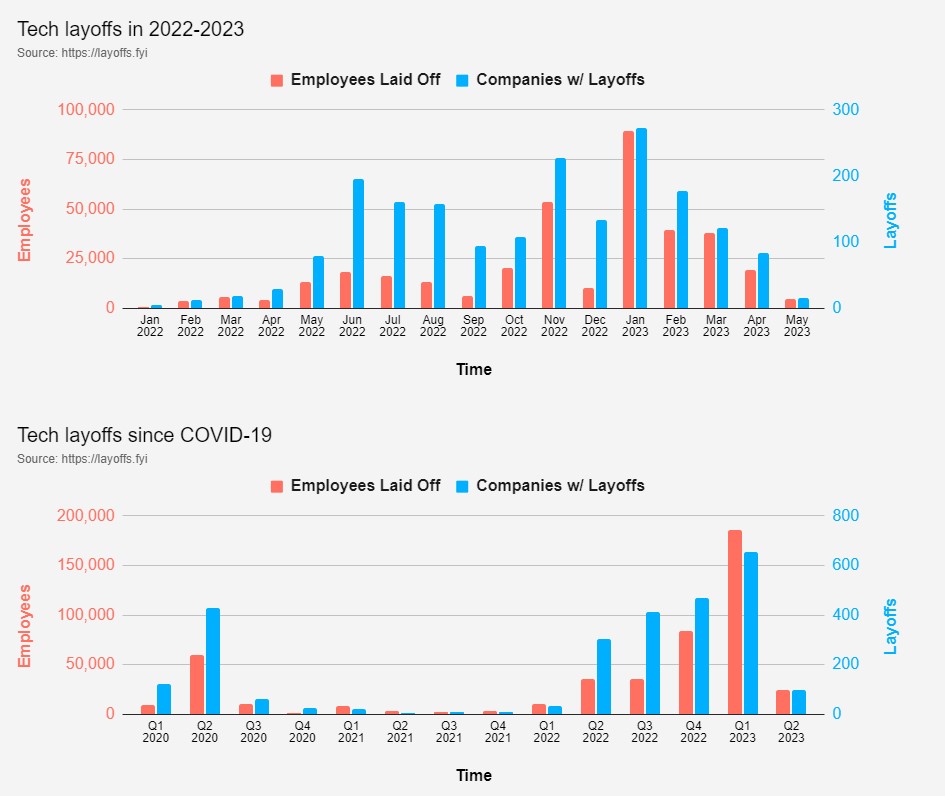
I've learned that "safety" in the tech industry comes from the fact that you can always work elsewhere.
It has huge potential
Despite the ongoing fear of Artificial Intelligence replacing humans, this industry reserves huge potential for those who want to be involved.
These days, every company is a tech company.
Every company is going through a moment of digital transformation and innovation.
We see a rise in food-tech, fashion-tech, and tech-for-good companies.
"Tech" is just everywhere.
The tech industry is the second most lucrative sector after finance.
[...]Those students will be best off pursuing a career in tech, despite recent layoffs at Meta Platforms Inc., Amazon.com Inc. and Alphabet Inc. Tech savvy is seen as ever more important in a world increasingly influenced by digital platforms, even as some worry AI may pose a threat to some entry level jobs.[BNN Bloomberg]
It's fast-paced

"Fast-paced" is the one term that you'll read a lot of time on job adverts. The tech industry is fast-changing, and this is reflected in the way of work.
A "fast-paced" workplace is where things can change rapidly, needing you to adapt quickly.
You can thrive even though you're not super technical
Many people in the tech industry don't have a technical background or a STEM degree.
I've met former journalists, retail assistants, teachers, etc., breaking into tech and doing wonderfully.
Related: What Tech Career Is Right For Me?
You'll have to keep learning new skills
The tech industry is ever-changing. To stay relevant, you'll have to learn new skills. This industry is for those who enjoy learning new things.
There is value in networking

I've written a lot about the importance of networking, especially in the tech industry.
I've seen countless times people landing jobs through other people.
It's one way you could survive staying unemployed for an extended period. Network and invest in your network.
No one owes you anything
This is dedicated to those who have a degree.
Even though you possess a degree, you still have to put in the same effort as others and go through interviews like everyone else.
A degree doesn't make you entitled to anything.
Titles are often inflated
What is title inflation?
[...]It refers to the practice of giving employees inflated job titles that do not accurately reflect their actual responsibilities and level of seniority within the organization.[Saksham Kumar - LinkedIn]
I didn't understand this until I started doing more interviews and job searching.
You'll experience title inflation a lot in this industry.
Why does this happen?
It could be a way for companies to attract candidates or compete with other companies.
Either way, titles don't always reflect the skill and experience of a person.
Work-life balance is company and team dependent

Externally, the tech industry is known for two things: the optimal work-life balance it offers and the high burnout rate.
Work-life balance will depend on the company and the team.
Some teams have better work-life balance than others because of better planning and organization. Others struggle in this area.
Changing companies is the best way to get a salary bump
The number one to get a salary hike is to change companies every 2-3 years.
This is unfortunate because people often find themselves in great companies and teams, but for various reasons (change of circumstances, expanding family, etc.), they need to change companies.
Most companies offer a 2%-3% annual raise.
So many tech professionals prefer to change the company for a 20%+ salary hike completely.
Sales is a valuable skill

Being able to sell is a valuable skill.
In my personal experience, those who get the job are the ones who know how to sell and present themselves.
Key Takeaways
This article has covered what I've learned in 4 years in this industry:
It's unstable.
It has huge potential.
It's fast-paced.
You can thrive even though you're not super technical.
You'll have to keep learning new skills.
There is value in networking.
No one owes you anything.
Titles are often inflated.
Work-life balance is often company and team dependent.
Changing companies is often the best way to get a salary bump.
Sales is a valuable skill.
What have you learned during your time in the tech industry? Let me know in the comments (and - don't forget to subscribe to my FREE weekly newsletter).
Until next time!
🙋🏾♀️
About the author
Software engineer turned technical writer.
Comments
Join the discussionNo comments yet. Be the first to comment.